Showing posts with label Cronenberg. Show all posts

Thursday, October 6, 2016

31 Days, 31 Horror Movies: Videodrome

Videodrome

"Long live the new flesh."

In 1984 or 1985 I saw Videodrome for the first time and it blew my mind. I think I rewatched it immediately, just trying to get a handle on what the hell I had just seen. Cronenberg's films were always an experience - a potent combination of fear, flesh and fantasy that never failed to fascinate and repulse in equal measure. I loved Scanners and The Brood and of course his big breakthrough, The Fly, was just around the corner. Videodrome, though... Videodrome was something special. For the longest time Videodrome was my favorite Cronenberg film. (And may be again.) He's made more polished films, grosser films, even stranger films (Naked Lunch qualifies on all those levels, actually) - but this particular movie has always just worked for me. Yes, the effects haven't aged well, and the ending still frustrates, but in general I find that Videodrome always seems relevant. Even if community cable is about as dead as VHS.

Well, deader than this VHS tape, anyway.

Somehow, I never got around to owning any of Cronenberg's films until recently (starting with Criterion's Scanners release). I'm not really sure why that is - I've owned like 10 versions of Evil Dead over the years, but no copy of The Fly or Rabid. Maybe it was because in the back of my mind I was always afraid that I'd go to watch one and find that it was breathing, pulsating, maybe even breeding with the other movies next to it on the shelf. Videodrome put THAT imagery in my head. Lord knows what else it put in there.

The Medium
Last year my wife got me the Criterion Collection release of Videodrome, and it's gorgeous as all their releases are. If I'm honest, I like both the Godzilla and the Scanners packaging more, but it's still pretty cool. The case itself is done up as a VHS tape (it actually looks more like Betamax, but whatever), complete with handwritten labels. The picture quality is as good as you're going to get with an early 80's Cronenberg picture, and is a far cry from the last time I had seen the film - which was on VHS! There are a ton of extras as well - it's definitely worth picking up.

The Movie
Max Renn (a typically jittery and slightly sleazy James Woods), the owner of an obscure Tornoto cable station, CIVIC-TV, is looking for something - anything - to help his small station break through with a larger audience. His engineer, Harlan, shows him a pirated broadcast of a show called Videodrome - something new out of Malaysia. CIVIC-TV already shows mostly softcore porn and violence, but Videodrome takes it a step further. It's nothing but torture and murder in a red room with a red clay wall. Max is infatuated and orders his engineer, Harlan, to start pirating the show for use on his station.

"Also, if you could pirate Game of Thrones, that would awesome."

Nowadays the Videodrome broadcasts look a little tame. A little 'soft' in Max's words. But Videodrome was made an age where you could only use the word 'bra' once in any given episode of a TV show. For the time it looked like it was just this side of a snuff film.

The low resolution makes it worse, somehow.

Later, Max appears on a local talk show (for a rival station, one assumes) where he's pressed to defend his programming. Hi launches into a half-hearted defense of video pornography and violence as harmless outlets for his viewers - a way for them to experience things vicariously so they don't pursue them in real life. He's more interested in another guest, Nicki Brand (Debbie Harry), however, and the show concludes with a diatribe by someone called Professor Oblivion - who only appears via a TV screen. Oblivion opines that television is becoming the dominant expression of reality for most people - that, indeed, TV will eventually replace reality.

Max and Nicki start a relationship and one night at Max's apartment she comes across videotapes of the Videodrome broadcasts. She finds the show incredibly exciting, and convinces Max to engage in some cutting and mild bloodletting during sex, as Videodrome plays in the background. Max has a vision of them writhing together on the set of Videodrome. It's a hallucination - his first. It won't be his last.

I can't follow the logic where this seems like a good idea.

I know I keep going back to talking about the context of this film - the mid 1980's - but I'm constantly surprised at how tame things seem to me now. Things that seemed transgressive and violent and strange when I first saw them are... not necessarily passé, but  acceptable, if that makes sense. Watching the lead singer of Blondie get her ears pierced by James Woods while he licked blood off the needle? That was some strong shit in Reagan's America!

Harlan discovers that the signal is actually originating much closer than Malaysia - Pittsburgh, to be exact. Max tries to use contacts to get in touch with the producers, only to be told by his friend Masha to leave it alone. It's not faked, she says - it's REAL. And the people involved are dangerous - they're not doing it for ratings or even creative vision. It's all part of some political philosophy - they're believers. Max manages to get a name out of her, though - Oblivion. Professor Brian Oblivion.

And don't call him 'Mr Oblivion' - he worked hard for tenure, dammit!

As Max's hallucinations get worse, he manages to track Oblivion down to the Cathode Ray Mission, where homeless people are given food and clothing while they watch hours and hours of television. It seems weird, this sort of 'TV soup kitchen' - but in a world where society is defined by its communal experience, TV was the biggest shared experience of all. The idea of letting the destitute keep that connection was ahead of its time. Today if you don't have access through a phone or internet provider you can go into any public library and check your email, the news, browse your favorite blogs or post on Instagram. You can connect, keep plugged into the world. It's a public service. I don't look at the Cathode Ray Mission any differently now, as strange as it seemed at the time.

Wait, IS that my local library?

The Mission is actually run by Oblivion's daughter, Bianca who shares her father's goal of replacing vast swaths of human experience with the televised equivalent. Later, Max receives a videotape of Professor Oblivion explaining that Videodrome is actually a weapon, a first shot in a war for the hearts and minds of the people of North America. The show is secondary - it's the signal that's broadcast with the show that's the real key. It changes the viewer, causing a tumor to grow in the brain. The tumor causes the hallucinations - or is it the hallucinations that cause the tumor?

Many of Cronenberg's early films express fear of corporate or government conspiracy in them, exploiting science for some dark and barely comprehensible end. Videodrome is no different, with a shadowy conspiracy who want to make North America strong by weeding out the weak, the deviant and the undesirable, turning them into programmed assassins for the new world order. Max has already begun to change and soon he's completely under their control - programmed by videotape inserted into an orifice that opens up in his stomach. Betrayed by Harlan, who never really intercepted the Videodrome broadcast - he brought it to Max specifically.
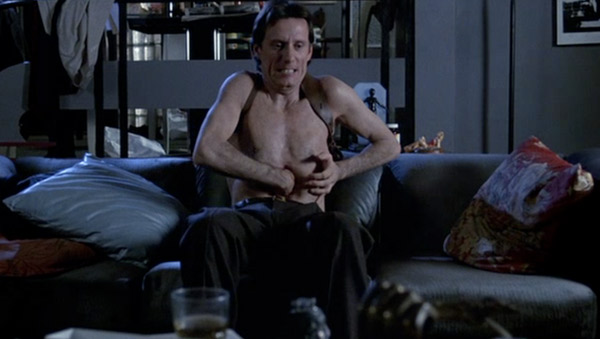
I know that remote is in here somewhere...

The first time I watched the movie I took the more outrageous changes in Max - the stomach slot, the gun-hand - as if they were literal. That he was physically changing as the result of the Videodrome signal. I don't think that's the intent, though. I think we're supposed to be seeing the film through Max's eyes, and after a certain point he's no longer viewing reality. Still, maybe Oblivion is right and TV is becoming reality, maybe Max is no longer just being programmed, maybe he's programming the world around him. It'd make the ending of the film a little bit less of a dead-end moment.


I love this show!

In some ways, we're safer than ever from a Videodrome world. Reality as represented by the cathode ray tube or LED display is no longer a few monolithic channels seen by all. Our communal reality is now realities. Our viewing is so fragmented these days - innumerable cable channels, YouTube, Twitch, Netflix - and those are mostly mainstream. You can find stuff way worse than Videodrome in a casual surf of the net. Hell, there are people Periscoping their own deaths. In a way, that makes us safer from a mass media conspiracy like Videodrome presents.

On the other hand, we've segmented ourselves into niche markets so readily that advertising doesn't even have to do research anymore. They can target specific demographics directly via the websites they frequent, the cable channels they watch, the messageboards they post on. The realities we experience are getting more claustrophobic and insular, the people we share them with reflecting only our own expectations back to us. Actually, maybe we're MORE susceptible to a reality altering signal - maybe somebody has started using one already.

Long live the new flesh.

The Bottom Line
Videodrome is a fantastic freakshow, a literal mind-bender that questions reality, physicality, sexuality and how we interface with our technology. It's good stuff, weird and disturbing. One of Cronenberg's best.

Friday, October 17, 2014

31 Days, 31 Horror Movies: Scanners

Scanners

Scanners, man. Scanners.

Scanners is the only movie that gave me nightmares from just the TV spot. It's not even that scary of a commercial, but somehow it got to me. I remember the nightmare in detail even now, probably because even bad dreams don't usually fill me with the horrible sense of dread I got during that particular dream.

 It'll sound stupid, but here's the dream: I'm sitting in a chair in an all white room. In front of me is a front-loading dryer, which is also white. Behind and to the left of the washing machine is a doorway to a white hall that I can only make out because the light in the hall is slightly dimmer than the light in the room. In the dryer, slowly tumbling and making sounds like a steak sizzling on a pan, is a piece of meat. Not like a steak or something innocuous like that - it's obviously an organ of some kind, like a liver or a pancreas - something I can't immediately recognize, but just know came from inside a person. And for no reason at all I'm absolutely terrified by this piece of tumbling meat. Suddenly I see someone walk by outside the doorway - it's the guy from the commercial, the guy who looks kinda like Frank Oz (the guy whose head explodes, actually, but I didn't know that when I had the nightmare). I try and call out to him, but I can't speak. The door to the dryer is going to open soon. The organ - whatever it is, all red and leathery - will stop tumbling. I don't know what's going to happen then, but whatever it is will be awful.

Gaze into the face of true fear.

And then I woke up. See? Dumb dream. Still gives me a minor sense of dread just thinking about it, though.

You can see the TV spot that inspired it here: https://www.youtube.com/watch?v=ksQduKLehOU  (EDIT: It's actually this trailer, as my brother pointed out: https://www.youtube.com/watch?v=adxyW-rANuU)

When I finally did see the movie it was nowhere near as scary as my dream. It was, however, the coolest psychic powers movie I had ever seen. Watching it now you'll find that it's very slow and talky and most of the psychic stuff involves closeups of people who look like they're having a gas attack, but at the time it was frackin' amazing. That scene where Vale is basically hacking a computer with his mind and the bad guys shut the link off? In my head that shit was up there with Star Wars in awesomeness.

Not as cool as Imperial Stormtroopers, though.

I spent a good part of the eighties obsessed with psychic powers in movies and fiction. The first comic book character I created was a telekinetic. The second or third short story I ever wrote was about a guy who developed psychic powers and used them to kill the kids that were bullying him at school. (I would probably get suspended or expelled for writing something like that in school nowadays.) I can lay that fascination directly at Scanners' door - and it's a movie I re-watched a lot back then.

One last tangent (yeah, right) about my experience with the movie. The first time I watched it I loved it, but I was initially very confused. For some reason I had gotten it into my head that the movie was an adaptation of "Scanners Live in Vain" by Cordwainer Smith (which I still think would make a great movie). Took several minutes to adjust my expectations.

The Medium
I picked up the Criterion Collection Blu-ray release, and it's fantastic. The transfer itself is top notch - the best the movie has ever looked by far. It's not going to be as clean or detailed looking as a more modern movie - there's a significant amount of grain in certain scenes, for instance - but it looks very sharp. I've read some folks who have a problem with the color tone, which has a distinctly greenish cast, but it doesn't bother me.

There are quite a few extras, including trailers, interviews and Cronenberg's first feature-length film, Stereo (which I'm looking forward to watching). No commentary track, which is a little disappointing.

The packaging is also very nice, with an illustration theme that runs throughout the set. I personally like the art style a lot, but it's an individual taste thing. You can see a gallery of the images here: http://www.criterion.com/current/posts/3221-illustrating-scanners

The Movie
Scanners is a movie about people with a special ability called 'scanning.' It's a little like telepathy, but as described in the movie it's "the ability to connect two nervous systems separated by space." A scanner with enough power can read thoughts, speed up a heartbeat, control someone's actions, and even kill. There's also a telekinetic element and even some pyrokinesis - this stuff seems to fall out of the given definition of scanning, but it's all psychic powers, right? Right.

Hell if I know.

The movie follows a character named Cameron Vale (Stephen Lack) as he goes from homeless person to psychic spy. He's hauled out of being a transient after mentally assaulting an older lady in a shopping mall. He explains his attack by saying something like "she made me do it by thinking about me." There's all kinds of space in that statement to follow up - is it the abuser's "she made me do it" cry? Is there something about being an untrained scanner that means your mind is easily sucked in by those around you? Does an intense 'thought' provoke an intense response in a scanner? It looks deliberate - the attack - to me, so that "she made me" defense reveals a certain flaw in Vale's character if you look at it that way. None of those things are followed up on - it's just a throwaway line - but it's interesting to think about.

That's a total jackass look, though, right?

Cameron finds himself tied to a bed, dressed in white clothes, while a distinguished looking man in glasses (and black clothes) proceeds to psychically torture him with a crowd of people. Eventually the man, Dr. Paul Ruth (Patrick McGoohan) gives Cameron a drug called Ephemerol that dampens his abilities, allowing him to hear himself think for the first time. I'm not sure what the torture session was supposed to accomplish. It goes on way too long for it to be simply a way to show how effective the drug is (this is one of the scenes that slows the pace down a significant amount). It  really does feel like Dr. Ruth (yeah, I know) is purposefully torturing Cameron, breaking him down to the point that the relief the drug offers engenders a sense of gratitude in his torturer.

"At least it's not water boarding, am I right?"

Meanwhile, a company called ConSec (which actually employs Dr. Ruth) is having a demonstration - revealing to a select group of people that scanners exist and what they can do. The demonstration goes horribly awry however when the volunteer in the audience turns out to be a scanner himself, Darryl Revok (Michael Ironside). This leads up to that infamous head-explosion scene.

As a horror movie fan and a gore fan (though more in my teens and twenties than now), that head explosion was always the one against which any other gore effect was measured. It's just truly startling in its realism and graphic nature. It also occurs early enough in the movie to be a calling card - letting the audience know what they're in for.

The movie goes on to pit Revok and Vale against each other. Cameron tries to infiltrate a group of scanners in order to get access to Revok and stop him from killing or subsuming all other known scanners. Along the way he finds a group of unaffiliated scanners, including Kim Obrist (Jennifer O'Neill), but Revok seems to always been just one step behind, attacking and killing everyone Cameron comes into contact with.

With Kim's help Cameron finally infiltrates Revok's company, only to find that things are a lot more complicated than they at first appeared - Revok may be working for ConSec - or perhaps it's ConSec that's working for him. Either way, Revok's plan, a program called Ripe, is a massive conspiracy to create more scanners - and Dr. Ruth may be involved.

On the run from both Revok and ConSec, Vale attempts to download the information about Ripe by scanning the ConSec computer remotely. Security attempts to wipe the computer drive - and Vale - with explosive results.

"Dialup is so damn slooooowwww!!!"

This is still an awesome sequence, 80's phone connection and tape drives and all. As things go bad and stuff starts to explode on both sides of the connection I'm always filled with a level of uncomfortable glee - "that's what you get for messing with a scanner, asshole!" Small details like melted plastic running out of the phone mouthpiece as just fantastic. And if an exploding telephone booth is a bit goofy? Ah well - psychic powers, right? Whattaya gonna do?

Armed with the computer info, Vale and Kim uncover the truth about Ripe and Revok's plan, leading to a final confrontation from which neither Vale nor Revok will emerge unscathed.

It always looks like he went for a fart and got a bit more than planned.

The veins! The flames! It's a fantastic set piece. I never realized that Dick Smith had worked on this film - he's the guy who did makeup for The Exorcist and The Godfather, amongst others (his last film was apparently the remake of The House on Haunted Hill). There was a team of effects guys on this film, but a lot of this final confrontation was created by him.

Watching the film this time around, the creepiest part of the movie to me is the long-range plans of Revok. This is a man who is planning generations down the line. He's seeding the population with scanners and planning on culling and harvesting them into an army. He's got lists that include doctors and patient names and addresses and is willing to put the time and effort and inhuman patience into this plan.

I also still really like the way the powers are portrayed. Scanning is not some easy, twitch-reaction thing. It takes time to make the connection, effort and concentration to accomplish any effect. It looks painful and difficult. Yeah, there are a few too many shots of shaking jowls and rolling eyeballs, but it's still effective stuff. Before that guy's head explodes you feel the pressure building in his skull.

This is a rough estimate of how my migraines feel, by the way.

The movie is let down in a couple of spots. The pacing is off, with some parts being glacially slow and others being over before they have a real chance to get good. Vale's 'indoctrination' via crowd torture goes on way too long and his 'Rocky Training' moment with a yoga master is over almost before it begins. The lighting is often flat, often looking more like a 70's film than an early 80's one.

The biggest issue with the movie, though, is the lead. Stephen Lack's surname seems appropriate, as there is definitely something lacking in his performance. I actually think this lack of affect is intentional - Cameron is someone who has literally never had a moment in which to develop his own personality, so of course he's a bit of a cipher, a bit flat. It's not always enjoyable to watch, however - no matter how much I identified with him as a teen.

Is he mad? Scared? Confused? Constipated?

The other actors are much more fun to watch, with Michael Ironside always worth the price of admission and Patrick McGoohan providing much needed gravitas to all  his scenes. Jennifer O'Neill often looks a bit lost, but she balances that out with some very effective 'Blue Steel' looks as she 'scans' people.

Gotta love the choker plus necklace look.

The soundtrack by Howard Shore is great, with a lot of dissonant electronic chords and isolated piano keys. The theme music is appropriately bombastic and distinctive and adds a certain gothic atmosphere to the scenes in which it plays.

The Bottom Line
Scanners is an old favorite that, for me, holds up even now. It's got its rough spots - uneven pacing, a lackluster star - but it's still a classic. Every time I watch it I find new things to enjoy and think about.

Thursday, October 2, 2014

31 Days, 31 Horror Movies 2014: Shivers (aka, They Came From Within)

Shivers (aka They Came From Within)

Shivers is a movie about a sex zombie apocalypse.

It's also a movie about the isolation of modern life, relationships, infidelity, body horror, mad science, and venereal diseases. In other words, it's a David Cronenberg film.

Shivers was the one early Cronenberg film I hadn't seen (the feature releases, that is - I still haven't seen Stereo or Crimes of the Future). I'd heard about it, but could never find a copy. I remember reading an article about it during the 1980s - probably around the time that The Fly was being released - that called it the goriest and most disturbing of his films. By that point we'd had Rabid, The Brood, Scanners, and Videodrome, so that was saying something.

So it was always on my 'must watch' list, but I never was able to come across a copy - VHS or DVD. It's been on my Netflix "Availability Unknown" list for years and I'd given up on ever seeing it.

Forward to yesterday. I'd been planning on watching a Cronenberg film anyway - I picked up a copy of the Criterion Collection release of Scanners last month specifically for this thread. I'll end up watching it this month sometime, but during the day got a notification from Netflix saying that Shivers was now available on streaming. Plans went out the window - I was finally going to see one of the great white whales of my horror movie list.

The Medium
I'm guessing that someone is re-releasing Shivers on Blu-ray, because the streaming version is pretty high quality. Actually, let's not guess, the Internet is our friend... Yeah, looks like Arrow is releasing a Blu-ray edition next week. Region B only, though, so I won't be able to pick up a copy until a US company releases it - I'm not holding my breath.

I need love! And a decent blu-ray release in the US. I mean, come ON.

The picture quality, as mentioned, is pretty darn good for a streaming movie made for a shoestring in 1975. There were a few low-quality shots with some noise, but that could easily have been my connection. This is probably as good as it's gonna get for us in Region A. Enjoy your Region B release, Greenland.

The Movie
Shivers starts off with a come-on, one of those real estate video advertisements. This one is advertising the latest in luxury, the Starliner apartment complex. The building sits on an island reachable only be a single bridge. It's a self-contained living area with all the amenities one could want - including a store, a medical clinic, heated swimming pool, and parking garage. This is the primary movie location, of course. A modern, swinging apartment building - with plenty of great suites still available.

There's something a little sterile about the Starliner, though. It's a bit too shiny and clean. It's just like the brochure - a little lifeless. Of course that's all on the surface. Dig a little deeper and you'll find all kinds of things going on - horrible things.

Cronenberg introduces us to the location via a young couple who are inquiring about an apartment. They're buying into the illusion. Meanwhile, he juxtaposes their scenes with a brutal sequence going on in one of those very apartments. An older man is struggling violently with a very young woman. As the couple downstairs peruse listings and listen to the salesman's patter the young woman upstairs is strangled, stripped, cut open, and has acid poured into the incision. The older man then promptly cuts his own throat.

This is literally the least disturbing image from this scene.

This is pretty messed up stuff. The actress playing the victim is young enough that it almost felt like it was crossing a line. In that respect the movie immediately feels a little dangerous, a little transgressive. What sorts of things will a director do who's willing to do that?

Worse things, actually. Much worse things.

The older man turns out to be a scientist named Hobbs. The doctor-in-residence at Starliner - Roger St. Luc - is brought in during the police investigation and soon learns that Hobbs had a grant that involved using parasites as organ replacement. He begins to suspect that Hobbs may have been conducting his experiments in the field.

Hmm... maybe I should have worn gloves.

Meanwhile, a man named Nick is obviously sick, having developed some strange lumps on his stomach. He won't go see the doctor, but his wife goes to Dr. St. Luc anyway, and convinces the doctor to come up to their apartment later to see her husband. Unfortunately, things are going from bad to worse with Nick, and he ends up vomiting blood into the tub. A slimy trail leading down the drain reveals that more has come out of him than just blood.

St. Luc learns that the murdered woman was, despite her schoolgirl appearance, very promiscuous and has slept with a number of the men in the complex - including Nick. All of the men are now developing weird cysts in their stomach. An associate of Hobbs tells St. Luc that the parasite is transmitted like a venereal disease and that it acts like an aphrodisiac. It makes people amorous so it can spread.

And spread it does. The gross, sluglike things are moving all around the complex. They leap through the air to latch on to people's faces, they burst from stomachs and crawl out of mouths. In a memorable sequence one  of the parasites exits a bathtub drain and slides between a woman's legs.

I didn't know whether to laugh or throw up at this scene.

Things begin to spin out of control and the inhabitants quickly degenerate into wandering mobs of crazed rapists. In one of the most disturbing scenes an infected man enters an elevator with a woman and her young girl. The doors close. Later, the blood soaked little girl passes on the infection.

I told you. Much worse things.

The ending falls down a little bit, as the action devolves to a standard set of zombie movie chase scenes. The doctor tries to escape with his lover/nurse and they're both hunted throughout the complex before a final apocalyptic orgy at the heated pool. There's a nicely creepy denouement the next day with various people - who we know to be infected - leaving the apartment complex by car, one by one, heading to the city to spread the parasite. Our 'hero' included.

Pig-pile in the middle, pig-pile in the middle!

Technically, there are issues. The lighting is pretty flat, as it is in a lot of low-budget 1970's films. The editing is uninspired, as is the framing (with a few exceptions). The effects range from fairly realistic to laughably bad (it's really hard to make a penis-shaped slug seem threatening when it moves). Action sequences - of which there are too many as the film progresses - are poorly choreagraphed. The behavior of the parasites is inconsistent, as if Cronenberg changed his mind several times over the course of the film.  

The Bottom Line
I had ups and downs while watching this film. It's uneven and frustrating at times. People act in unbelievable ways. Some of the dialogue - particularly from the lead male - is recorded so low as to be almost inaudible. Some of the effects are bad enough that they puncture any tension a scene has built up.

Why are there all these wooden slats in the basement, anyway? Are we even still in the same movie?

And yet - I kept thinking about it after the credits rolled. The obvious references to STDs are only one layer of a complex film. There's a level that's a commentary on how, in a modern society, we never really know our neighbors and what's going on behind closed doors. There's a condemnation and fear of science run amok. There are questions of sexual identity and sexual politics. There's fear and repulsion at our own fleshy nature.

I think, in the end, the film works despite itself. It's rough in spots - and sometimes seems to be working primarily as a low-budget exploitation film - but It's an intriguing filmmaker's first foray into questions he'd explore in much more accomplished ways in films like Rabid and The Fly.