Showing posts with label Dario Argento. Show all posts

Wednesday, October 4, 2017

31 Days, 31 Horror Movies: The Bird With the Crystal Plumage

I should do these writeups earlier in the day, but I'm barely coherent without coffee. Anyway, last night's film was:

The Bird With The Crystal Plumage (1970)

I like to start off reviews of classic movies with my memory or experience with them. I don't know if it's helpful or not, but I just like people to know where I'm coming from, my particular biases/favoritism towards films I've already seen. Unfortunately, I can't do that with Dario Argento's first film, The Bird With The Crystal Plumage. I know I've seen it - watching it this time around I found the key scenes and set pieces familiar enough - but I couldn't tell you WHEN I first saw it. I'd like to think it was back in the days of VHS, but I've looked at the two VHS covers for the US releases and neither look familiar. (The one from United looks awesomely 80's in an Asia album cover sort of way.)

The more I think about it, the more likely it seems that I saw it through Netflix, back when they were strictly a DVD-by-mail outfit. I know I went on a bit of a splurge when they first started getting some of the obscure titles I hadn't been able to see or hadn't seen in years. (Like Zombie or Videodrome.) My Netflix activity list only goes back to 2013 and is probably the streaming only version, so I can't check. But yeah, I think if I'd seen Bird in my formative horror-watching years, I would have remembered it.

The Medium
I was lucky enough to trade for a copy of the recent Arrow Limited Edition. The packaging is pretty sharp, with a solid slipcase holding the Blu-ray case, a poster and a booklet with a few essays. Lobby card reproductions are included in the Blu-ray case.

So... sniff... so beautiful.

Quality wise - well, it's the best I've ever seen it, but given that I've probably only seen it on DVD it sort of has to be. With nothing to compare it to, all I can say is it looks extremely good for a movie released in 1970. The info on the box says this is a new restoration and, with my limited technical knowledge, it seems they did a fantastic job. Well worth picking up - especially when the non-limited set is released.

The Film
Sam Dalmas (Tony Musante), a brass, crass American writer living in Rome is heading back to his apartment when he sees a beautiful woman in white being assaulted by a mysterious figure in black. Racing to her aid he finds himself trapped between two glass walls, unable to help as the attacker escapes and is forced to watch as the woman struggles for breath and life. The woman survives and Sam is drawn into the investigation, which appears to be part of a larger pattern of attacks against young women around the city.

Are two sets of glass really a secure entry to a building?

Initially a suspect, Sam finds himself pursuing and pursued by the real killer, all while trying to decipher a general suspicion that he's seen something during the attack that could be important. The only question is - will he and his friends survive his amateur pursuit of the killer?
There are things that happen in the film before that first attack - there's scenes of a killer preparing and his target walking the streets, there's a scene with Sam and his editor talking about the publication of his newest book, a guide to the identification of birds. (This is where we get a first indicator of Sam's crassness - he's far more interested in the check than the book.) However, it's that first attack in the art gallery that causes you to sit up and take notice. Because it's... well, it's beautiful. A brightly lit white space framed in glass, a woman in white with a splash of red on her torso, the black-garbed figure dashing into the shadows. It's startling and riveting. While tame by modern standards (and very tame by Argento standards) it's still difficult to watch as the woman struggles, reaching out to Sam with blood-soaked hands and with him unable to do anything but impotently pound on the glass that separates them.

"I'm sorry, I'm just not getting it... two words, sounds like...?"

So, yeah, I like this film.

I like the characters - Tony Musante has a definite charisma that makes you like Sam, even if he's a bit of a prick sometimes, particularly to his girlfriend Julia (Suzy Kendal - who does yoeman's work with a thankless role). The detective in charge of the case, Inspector Morisini (Enrico Maria Salerno) is more likeable and more competent than you might expect from an Argento film - even if he's unable to keep a foreign citizen from meddling in a case, or even keep his own men from being killed.

"I also don't understand my phone bill. Explain again."

Everything I've read about The Bird With the Crystal Plumage mentions how the film was a watershed for Italian cinema. It revived and energized a genre - the giallo - that was moribund and failing, turning it into the one thing the Italian public wanted to see at the cinema. It also established a number of images and plot points that became standard for gialli going forward: Killers always wear gloves. Beautiful woman are always threatened. Killings are always stylish set pieces. The titles should be baroque and only tangentially related to the film. Finally, the plots must be intricate and feature several twists and turns before a final reveal. (That those plots make sense or even be internally consistent was not a requirement.)

Also, boobies.

Coming to the film late in my Argento viewing I find it to be one of the most straightforward and restrained films in his body of work. The plot is complicated, yes, but easy enough to follow and the twist is telegraphed fairly broadly, at least for me. The characters are more fully fleshed out than some of his later films and even the supporting actors make the most of what material they're given.

Even the killings aren't as elaborate or violent as they would come to be in Deep Red or Opera. That being said, it's almost more difficult to watch at times. There's a scene in which Julia is threatened by the killer. She's trapped in her apartment and the killer is slowly chopping away at the door. She's isolated, unable to call for help and has no way to escape. The scene seems endlessly long as she tries, desperately, to find a way to survive, before collapsing in terror to await the inevitable. It felt somehow darker and more cruel than later films where the violence made things quicker and the terror of the victims is thus mercifully curtailed.

The most excruciating scene - with absolutely no blood whatsoever.

One of the other things I noticed was the lack of the distinctive Argento/Goblin soundtrack. I realize it's probably and eighties thing, but I found myself looking for that synthesizer. Not to say the soundtrack is bad - Ennio Morricone doesn't do bad soundtracks. It's got an unsettling children's chorus during scenes with the killer and is generally serviceable. There's also more of a sense of humor than Argento's later films (though I found this to be the case in Four Flies on Grey Velvet as well). "Bring out the perverts!" Made me laugh, as did Moricini's line that one person "belongs with the cross-dressers, not the perverts!" (And the cross-dresser's response, "I should hope not.")

Let's just show this scene again for no reason.

The Bottom Line
For a first film, The Bird With The Crystal Plumage (said bird appears in approximately 10 seconds of the film) is an assured and masterful debut. It's still a low-budget Italian slasher flick, if you get right down to it, and if you don't like gialli in general, this is not going to float your boat. If you don't mind a little flash to your murder and a little nonsense to your plot twists, though, it's a pretty fantastic first film from one of the greats.

Monday, October 31, 2016

31 Days, 31 Horror Movies: Tenebrae

"It was like a book... a BOOK!"

I prefer my Argento with a touch of the supernatural. My favorite of his films remain Suspiria, Phenomena and (more recently) Inferno. That's not to say I don't love his other films - Deep Red is still a masterpiece, after all - it's just that I think his vision works better when there's something of the strange in it. It's easier to let go of the wandering narrative structure or mismanaged/dropped plot elements when there's a girl summoning flies or witches in the basement.

I think part of my preference my go back to the VHS days, when Argento films in the US were always heavily edited. The supernatural stuff just fared better, given that it was already pretty messed up. I saw Phenomena as Creepers, and even with the cuts it still had Jennifer Connelly and a chimp with a straight razor. I saw Tenebrae as Unsane back then, and my general memory of the film was 'meh.' It always ranked pretty low in my mental list of "Argento films to own or watch again." I probably wouldn't have bothered picking it up if I hadn't watched Inferno last year and had a completely different experience from my first viewing. I'd also heard that the original edit was a vastly improved film, with more character moments, a more comprehensible plot, and a lot more violence.

Violence?! In an Argento film? I was just as shocked as you are!

The Medium
Synapse released Tenebrae on blu-ray this past year. I didn't bother getting the 'limited edition steelbook' edition and was happy to purchase the regular release later this year. I don't really need the soundtrack (and have a few Goblin albums with the important pieces on it already). I will be jumping on the Phenomena and Suspiria releases - because I'm also a huge fanboy for those films. The picture quality was excellent and the extras are good, if sparse. The documentary on giallos is a good starting point/overview for those who haven't read much about the genre (I include myself in that group). I've only listened to the commentary for a few minutes, but it also seems to be decent.

The Movie
Peter Neil (Anthony Franciosa), author of crime thrillers, arrives in Rome for a book tour. Shortly before he arrives a young shoplifter is brutally murdered and pages from his most recent novel, Tenebrae, are found stuffed into her mouth. The police don't really suspect Neil - his alibi is air-tight - but the killer is obsessed, going so far as to send Neil letters about the killings.

I wanted to make a joke about eating your words, but it seems forced.
I'm sorry, I'll get my coat.

Suspects and red herrings abound, as per usual for an Argento giallo. And as usual the main character is a creative type - a writer, in this case, as in The Bird With the Crystal Plumage. Franciosa is a likeable actor and lends Neil more warmth and character than I normally expect from an Argento lead. Daria Nicolodi's role as his 'girl Friday', Anne, is pretty thin for her - a sort of non-entity and not what I expect from Nicolodi, who's usually more interesting to watch. The supporting characters are where the most fun is to be had, particularly Detective Giermani, who can never quite figure out who the murderer is - in mystery novels, at least.

"Evin with Scooby Doo! Old Man Smithers? I never saw that coming."

Tenebrae is restrained for Argento, with few of the more outrageous excesses of style - at least early on. Not to say there isn't style, it's just more... realistic. Even the big tour-de-force scene with a roaming camera around an apartment building is just impressive, rather than being extravagant. The film is easy to follow and the characters aren't too outre' or weird. You may think you know who the killer is fairly early on, and that may initially be disappointing, but as that character is killed about half way through the film you don't want to get too comfortable.

No need to freak out, either, though.

Argento likes to play with images and symbolism, so there's a lot going on in Tenebrae below the surface, if you want to look deeper (there's a character connection with water, for instance, that informs the words I used in this sentence). He plays with light, music, reflections and doubles. On some level he's also asking a question about art and the responsibility of the creator. At its most basic level the question is - if you write/draw/film about monsters, does that make you a monster? I think Argento is aware enough to laugh at the question with this film.

And 'axe' his critics a few questions.

As always he makes the kills so stylish and interesting they become art pieces. The violence is pretty restrained, for Argento - there's still blood and blades and boobs, as expected, but it's still pretty tame compared to previous films. Until suddenly it's not. There's a sequence near the end of the film that's one of the bloodiest scenes in all of Argento's films - a wall is literally painted in arterial spray, there are dismemberments and axe blows and throat slittings and art piercings (you'll just have to see it). It's such a shock after the relatively tame murders that came before  - particularly that dismemberment and the blood spray - that I blurted out "holy shit" when it happened. I know I'd never seen that scene before, and indeed much of it had been cut from Unsane. (I understand that it was also cut severely in Italian releases after the actress - Veronica Lario - got married to former Italian Prime Minister Silvio Berlusconi.)

You know I had to add a cap of this scene. Just be glad it isn't animated.

The drawbacks of most Argento films are also on display here - there are jumps in logic and behavior that you have to just go with. There are events that seem unlikely or implausible. The plot - though tighter than some of Argento's films - still has holes. There are a few sequences - one near the end in particular - that bear no scrutiny whatsoever. And, as with most Argento films, I find the ride more than fun enough that I let it all pass.

The Bottom Line
Watching Tenebrae this time around was a much different experience, at least in part due to the 'restored' or original cut of the film. For one thing - it actually makes sense (for an Argento film). For another, the violence is much more graphic than I remembered (and I would have remembered that arm chopping sequence, had it been in the Unsane cut). It also seems like it will be a film that rewards a closer viewing, despite the jumps and twists having been given away. I still prefer the supernatural in my Argento films - but this one's pretty good, too.

Friday, October 23, 2015

31 Days, 31 Horror Movies: Inferno

Inferno
My Argento viewing is spotty. I came to Italian horror movies pretty late, and I don't know that I've ever really caught up. Fulci and Argento in particular have large bodies of work - not all of it horror - and I slowly slot things in as mood and opportunity collide. For instance, I've seen Fulci's Sword & Sorcery entry, Conquest, but still haven't seen New York Ripper. Argento has fewer films, but I still haven't seen Opera or Mother of Tears.

This is to explain that I only recently (in the last five years or so) watched Inferno. This is despite that fact that this movie is a sequel of sorts to my absolute favorite Argento film, Suspiria. I think part of me knew I would be disappointed - and it's true, I was. Sorely disappointed. I remember thinking how poor this film was not only in comparison to Suspiria, but to the level of quality of every other Argento film I had seen. I remembered liking the underwater room below the basement... and that was it.

Still one of the coolest parts fo the film.
Over the last year I've been contemplating finally seeing Mother of Tears - the conclusion of Argento's "Three Mothers" trilogy (along with Inferno and Suspiria). I've heard nothing but bad things about it, but it still seems like something I should watch. As a preamble to watching it I thought I should probably re-watch Inferno. Yeah, it was bad, but I felt I should at least rewatch all of the stuff about the Three Mothers. I saw the film was available on Hulu and had once again run out of time to watch Kwaidan last night, so I started it up...

And it was like a completely different movie. Seriously - the movie in my head was of such low quality that I could have mistaken it for a later (or earlier) Fulci film. Flat lighting, bad music - just a terrible production. At least that's what I remembered. I must have been in quite a mood that day. Because it's really quite good, at least on par with Cat o Nine Tails and The Bird With The Crystal Plumage, though not quite up to the level of Deep Red, Suspiria, or even Phenomena.

The Medium
I watched Inferno on Hulu, as I mentioned, but I think I might have to pick up the blu-ray now - the colors alone are worth it.

The Movie
Inferno is classic Argento. A loose plot that is an excuse to string together violent and stylish set pieces set to electronic/rock music (leavened in this case with some Verdi). There's dramatic use of color, plenty of blood, bizarre sets and characters as well as the inevitable twists of identity.

If Call of Cthulhu has taught me anything, it's that poets and mysterious tomes should never cross paths.

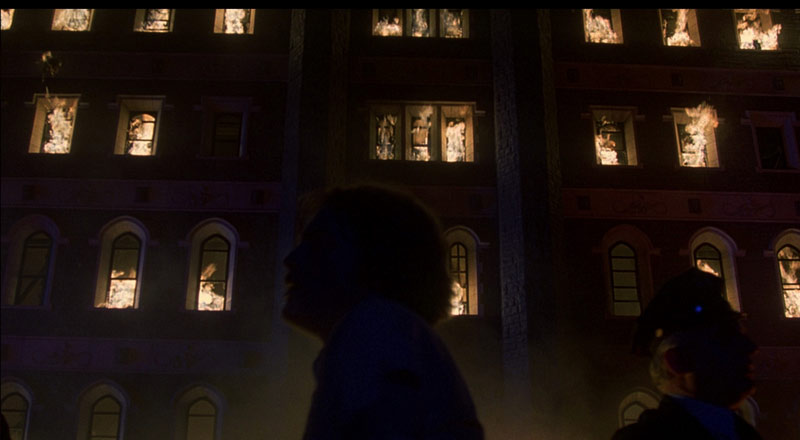
The movie is, nominally, about a resident of a building in New York City, Rose. She comes across a book called The Three Mothers, written by an Italian architect that claims he created buildings for each of three evil sisters who rule the world - Mater Suspiriorum, Mater Tenebrarum and Mater Lachrymarum. Rose begins to suspect that her residence is one of those buildings. Using clues in the book she explores the building, finding - among other things - a flooded room below the basement level.

She sends a letter to her brother Mark who is at music school in Italy. He misplaces it and a classmate, Sara, reads it instead. Intrigued, she heads to a library to find a copy of The Three Mothers. She attempts to steal the book, but is attacked by a strange figure and drops it. Fleeing to her apartment she asks a neighbor to come stay with her, as she's afraid. Both of them are murdered. (I note that actors in Argento films use the same advice my first acting professor game me, "Face front, talk loud, die slow.")

If this was the basement of my local library I'd be terrified too.
Mark finds the bodies and fragments of his sisters letter. This and a brief phone call with Rose lead him to New York, but when he arrives his sister is missing. Of course by this point we have already seen someone - or something - stalk Rose through the building before killing her. The building is... well, let's just say it's probably not up to code. Between the hidden areas, the broken windows and the weird voice-carrying tubes it's safe to say this is probably a sister building to the one in Ghostbusters. Built for purposes other than human habitation.

Let me see if this location is in Tobin's Spirit Guide...
Mark doesn't find his sister, but he does meet some of the other tenants, including a nurse - caring for a weelchair bound professor, a caretaker and the Countess Elise and her manservant. With Elise's help he finds bloodstains outside Rose's apartment. When he follows them he's overcome by gas and Elise is stabbed to death. Mark makes his way to the lobby where he collapses.

This is not the lobby. But it should be.
The murders come swiftly after that - the old book shop owner who sold Rose The Three Mothers is attacked by rats - and a hot dog stand vendor - in Central Park. Elise's manservant is murdered and the caretaker is so startled by his corpse that she sets the apartment on fire with a dropped candle - she ends up on fire and falls out a window.

I'm not sure why or how this all fits together. I get the vague sense that someone - Mater  Tenebrarum, probably - is destroying copies of The Three Mothers and most of the murders are just cleaning up her tracks. The death of the bookseller also suggests that she has a wide network of agents - as does a mysterious woman in Italy that Mark sees a few times (unless she's supposed to be the Mother of Tears). Other deaths aren't so clear cut and it's possible the caretaker and Countess' butler murder Elise for their own agenda. It's all a bit confusing towards the end, but stylishly so.

Speaking of stylishly confusing...
Mark eventually finds a secret floor beneath his sister's apartment. Descending into the depths of the building he confronts first the architect and finally the Mother of Shadows herself in a final apocalyptic inferno.

Oh, you meant a literal Inferno! My bad.
Inferno is a bit too uneven to really be on par with Suspiria. Pacing is disjointed and no character is really given enough time to flesh them out or make us care about them. It also makes the mistake of giving us both too much information (all that voiceover reading of the book, as well as Mater Tenebrarum's final monologue) and not enough. Are all the events orchestrated by the Mother of Shadows? If so, what was the point? What was her endgame? The fire seems beyond her control, but she's not surprised. And Mark lives, so if her goal was to destroy any evidence of her existence then that plan failed.

Maybe my failure is to try and make sense of an Argento plot.

Tuesday, October 28, 2014

31 Days, 31 Horror Movies: Four Flies on Grey Velvet


Four Flies on Grey Velvet

I never even heard of this film until recently. It was apparently released in the US for the first time in 2009, and only sporadically elsewhere in what might have been bootleg versions. It's Argento's third film and is sometimes referenced as the final part of his 'Animal Trilogy' - along with The Bird With the Crystal Plumage and The Cat o' Nine Tails. (There's really no connection other than the titles, so FFoGV can be safely watched without having seen the other films.)

I went into this knowing nothing about it, except that it was an Argento film I hadn't seen. (There are a few, actually, but this was the only one I that was completely new to me.) My enjoyment of the film may be outsized compared to the actual quality (and the quality of later films, like Deep Red or Suspiria), but that's probably a result of watching it so soon after Fulci's A Cat in the Brain. The difference in level of quality and skill was pretty striking.

The Medium
I watched Four Flies on Grey Velvet via streaming. The quality was decent, though not HD. It had the '40 missing seconds' added, but in Italian and without subtitles. If the movie is ever released on Blu-ray in the US, I'll probably pick it up.

The Movie
Roberto is a drummer in a rock band. (All the music is provided by Enio Morricone and there's prog-rock, jazz and some electronic sounding stuff.)  There's a mysterious figure following him around after rehearsals and even during the day. One night he finally confronts the stalker, having followed them to an abandoned theater. The stalker pulls a knife, they struggle and in the melee Roberto stabs the stalker. This is bad enough, but there's also someone else in the theater. Someone wearing a creepy puppet mask takes pictures of Robert standing over the body, holding the bloody knife. Roberto runs, but is soon contacted by the person who took the pictures. They're not going to the police, no - they want to torment Robert, before killing him.

"This was not at all how I saw my day going."


Man this is a stylish film. I know that's like Argento's thing, but there's some really awesome cinematography and framing in this film.  Right off the bat we've got shots from the inside of a guitar, slow spins to reveal people standing outside of windows, and a shot of a fly between two cymbals with the drummer out of focus behind it. It's just so visually interesting compared to Fulci's straightforward compositions. 

Also, that puppet mask? That is damn creepy. I kind of wish it had kept appearing throughout the film, but it's not that sort of giallo.

Peekaboo!

I'm not sure what to make of Roberto. He seems a likeable enough guy, but he's also willing to cover up his involvement in a man's death. He appears to be somewhat distant and isolated, even from his beautiful wife and his band mates. Maybe that's just the stress he's under, but it ended up having the effect of leaving me feeling distanced from him as well.

"I just feel flat and uninspired, you know?"
"Something feels flat and uninspired."

There's a shot that appears to be a cemetery. Headstones in a white glare, over-exposed. Then the contrast starts to drop, the glare fades... and it's a public square on a middle-eastern country. What we thought were tombstones are actually the curved entrances into the surrounding building. There's a public execution going on and we watch the executioner begin his work. This is a recurring dream that Roberto has and is one of the few potentially supernatural touches in the film - if we take it as a premonition. Though it's just as likely that it's a representation of Roberto's increasing fear and paranoia, mixed with a story told at a party.

The blackmailer invades Roberto's house, leaving pictures of the killing. They even enter at night and almost kill Roberto with a garrote before telling him that they want him to suffer first. At this point I'd be going to the police, murder rap or no, but instead Robert seeks out the advice of God.

Not the God you were expecting, I'm sure.

I don't generally expect a Dario Argento film to be funny. So when Roberto goes to talk to his friend Godfrey and calls out 'hey God!' and there's a burst of music and a chorus singing 'hallelujah!' I almost snorted my drink. There's a substantial amount of humor in the film - between a bumbling mailman, God and the Professor (two homeless gentlemen), and a gay detective. Whether it works for anyone else or not, I actually enjoyed the humor. It's a little jarring, but the scenes - particularly with God and the Professor talking to Roberto at a Funeral Arts convention - are just hilarious to me. (One of the people at the convention tries lying in a coffin only to complain that it's a little too tight. The response of the vendor - "None of our customers have ever come back with a complaint...")

Roberto spends a lot of the film in this exact pose.

The gay detective is way too over the top, but the actor is so good in the role that I can almost forgive the cartoony nature of the presentation. I found myself wishing the entire movie was about this guy on his quest to finally solve a case. He's only around for a short time, though, and he's sorely missed after an unfortunate meeting with the killer. I was pretty impressed that there was a positively portrayed gay character in a giallo in 1971, even if he's almost a caricature.

Roberto, second guessing the 'and expenses' part of the deal with Detective Arrosio.

There are a number of plot twists and turns of course. This is, after all, an Argento film. Murders are highly stylized affairs with inventive and almost beautiful imagery. A maid out to blackmail the blackmailer is in a park full of people during the day - and then she's suddenly alone at night, locked in with the blackmailer (who quickly becomes a killer). A cousin of Roberto's wife is a suspect - until she too is murdered in spectacular style.

And then - oh dear. The 'last image can be recovered from the victim's eyes' crap. This is why I quit watching Fringe the first time it aired.  It's still dumb... but it does look kinda cool, with eyeballs, lasers, glass globes, and a blurry image projected on a circular screen.

Very dumb, but very cool.

The end comes quickly after the reveal of the murderer - there's some crappy pop psychology, slow motion bullet time (decades before The Matrix - though it's pretty limited), slow motion car crash decapitations and more prog-rock soundtrack music than you can shake a stick at. Does it all make sense? Probably not - though it felt more coherent than some of Argento's films.

The acting is fairly decent, if broad, and I was pleasantly surprised by the dubbing. Mimsy Farmer as Roberto's wife Nina is a standout, as is Jean-Pierre Marielle as the detective Arrosio. The final confrontation was marred by the inclusion of several seconds that had been excluded from previous versions of the film. These are mostly part of a sequence in which the killer explains their actions and are all in Italian with no subtitles. So I was left with the impression that the killer had gone crazy because sometimes they just randomly speak in Italian.

"See you in your nightmares!"

The Bottom Line
This is a really enjoyable giallo with all that entails - including elaborate killings, stylish people and settings, and some convoluted plot twists. It may not represent Argento at the height of his powers, but it's still a pretty entertaining film.