Friday, October 14, 2016

31 Days, 31 Horror Movies: Horror of Dracula

Sometimes I'm in the mood for a particular type of horror movie. Giant bugs, slasher flicks, found footage, Italian gialos, etc. Whatever it is, anything else just won't do. I've tried to watch other types of horror films when I'm in that mood and it's inevitably a bad time. I don't enjoy myself and whatever film I'm watching gets short shrift as a result (I'm thinking of Kill Baby, Kill last year in particular). It's harder when you're working from a set list (I swear I'll stop complaining about that soon), as the odds of scratching that particular itch are stacked against you.

Not Megaphython vs Gataroid! Anything but that!


Happily when the urge to watch some Hammer Films Dracula hit me, I saw there were not just one but TWO films on the recommended list (from 2014).

Hammer Dracula part one: Horror of Dracula
Hammer films weren't as much a feature of my childhood as the classic Universal monster films were, but I did see them from time to time. Quatermass and the Pit remains a favorite and The Mummy (with Lee in the title role) was a particular standout, in part because of my profound disappointment with the Universal title. I know I saw the Dracula and Frankenstein films, but I'm ashamed to say they often got mixed up in my head the Poe film cycle of Roger Corman. They had the same lush colors, set design, and period costuming.

Now that I'm an experienced horror film enthusiast I can totally tell when I'm when I'm watching a Corman film instead of a Hammer one. Especially if Vincent Price is in it...

The Medium
Purchased on Amazon. The streaming quality was... serviceable. I really need to pick up some of the Hammer films on DVD or preferably blu-ray, but I don't even know if they're currently available!

The Movie
Christopher Lee and Peter Cushing. Peter Cushing and Christopher Lee. Peter Lee and Christopher Cushing... wait, no, strike that last pair. I love seeing either of those actors on screen and any movie in which they both appear is instantly a much better film for it. This is, of course, their classic pairing - with Christopher Lee playing the Count and Peter Cushing his constant foe, Abraham Van Helsing.

Was this in the Special Editions? Stop screwing with them, Lucas!


But first, we must contend with Jonathan Harker, played with smirking smarminess by John Van Eyssen. I know he's supposed to be heroic, but I've always found this character to be totally deserving of his fate. I like the twist - instead of an unknowing victim, Harker is a hunter and has accepted an appointment as Count Dracula's Librarian solely to get close enough to kill the vampire. Unfortunately he's not that bright and wastes precious time taking out one of Dracula's brides. When his mentor Abraham Van Helsing arrives to help, he's far too late.

The thing about Christopher Lee's Dracula that made him so indelible, to me anyway, was how vicious and almost feral he could appear. He was gracious and erudite and cultured - until it was time to suck some blood. And then he was suddenly all fangs, wild hair and bloodshot eyes. I could totally buy him as a monster vindictive enough to head out and try to destroy Harker's family.

Will also totally send his steak back if it's not cooked perfectly.


The names are all familiar - Jonathan, Lucy, Mina, Arthur - but the details are different, which can take a moment to get used to if you're a fan of the novel. Harker's fiancé in this film is actually Lucy (Holmwood - Lord Godalming's sister in this imaging), Mina is married to Arthur Holmwood. The changes quickly fade into the background as Van Helsing arrives, Lucy falls prey to Dracula, and the Holmwoods are forced to fight for their existence against the lord of the undead.

"No, you don't look anything like Bruce Wayne's butler, dear."


There's just something about Peter Cushing that makes you like and trust him, and his Van Helsing is one of his most likeable and enduring characters. He's so charming I found myself annoyed at Michael Gough's Arthur, who has a (completely understandable) dislike of Van Helsing, being involved as he is in both Harker and - later - Lucy's deaths.

Disfiguring her before staking her DOES seem like a dick move, though.


So much good stuff here. This was Hammer in their heyday, with gorgeous production and excellent mood, music and, of course, some amazing stars. It would be decades before the bodices became optional and the blood more plentiful. I do wish there had been more of an opportunity for the two main stars to interact with each other - I'm not even sure Van Helsing and Dracula exhange a single word - but just seeing them on screen at the same time is a bit of a thrill. The final confrontation is still quite good, special effects wise, though it's over too quickly.


Though probably not quickly enough for Dracula.

The Bottom Line
Horror of Dracula is probably the most recognizable of the Hammer Classic Monster films. I think there were better installments in the series, and my heart will always belong to the more esoteric productions like Quatermass and even Vampire Circus, but sometimes only the classics will do. Do you have to be in a particular mood to enjoy them? I don't think so - but it doesn't hurt!

Tomorrow: Van Helsing vs Gilderoy Lockhart... er, Bride of Dracula

Tuesday, October 11, 2016

31 Days, 31 Horror Movies: Unintended Final Destination Double Feature

So I watched Final Destination last night, and then this morning realized that it was actually Final Destination 2 that had been recommended to me. SO - unintentional theme nights! I might not be able to watch anything tomorrow - and will almost certainly not be able to post (I'll be spending 6-7 hours on the road), so I figured I'd write them both up tonight.

Final Destination 1 and 2

I saw the first Final Destination a long time ago (it came out in 2000, which is long enough ago to have freaked me out a bit when I realized that). I enjoyed it, but not a lot and not enough for it to make a real dent in my general disdain for the late 90's/early 00's horror desert. It wasn't until 2002 and 28 Days Later and The Ring that I started to feel like what Hollywood was calling horror was worth seeing again, rather than I Know What You Did Last Summer or Scream sequels. (As with anything, there were exceptions: Blair Witch, Event Horizon, and In the Mouth of Madness, to name a few.)

The point is, Final Destination was a blip, a nothing. I was vaguely aware that there were sequels, but I was always generally wary of franchise horror anyway - and nothing in the first film made me think the follow-ups would be worth watching. To be honest - wasn't really looking forward to watching it again.

Me, trying to get up the interest to watch the movie.


The Medium
I watched both films on Amazon. The first is available as part of Amazon Prime. Part three is available on Netflix. The others (there are five in total) aren't on any streaming service I pay for - but are available for rent. This is where I quietly protest that having rando numbers of a series is just wrong and all streaming services should go in a corner and think about what they've done.

The Movies

Final Destination
Alright, let me just get right to it: I enjoyed this movie this time around. In fact, I enjoyed it a lot. There. Admitting you have a problem is the first step, right? Yes, the acting is not always (or often) very good. And yes, the plot is basically an excuse to string together some elaborate deaths. And yet there's just something about it...

Alex (Devon Sawa, looking like an adolescent Jeremy Renner) has a dream in which the plane he's on explodes. He freaks out and a number of people - mostly classmates and one teacher - end up being told to leave the plane. Which then takes off and promptly explodes. Alex and his classmates struggle with various degrees of survivor's guilt - and various levels of dislike of/gratitude to Alex - until it becomes clear that they are all dying, one by one. Death, it seems, doesn't like to be cheated.

None of these people end up on the island in Lost.

That's the basic plot. There are more details - Tony Todd even lays down some basic rules as a creepy mortician (listen to the Candyman, kiddies, dude knows what he's talking about) - but they're incidental. What matters is that death is coming for each of them, and it will stack the deck - with lots of ways for each character to die - until it gets them all.

Lot of familiar faces in this movie. Part of that is Glen Morgan and James Wong (writers, as well as Producer and Director respectively) - they've brought a some folks with them from The X-Files and Space, Above and Beyond. Tony Todd. Others like Ali Larter, Kerr Smith and Sean William Scott have gone on to have pretty good careers. I kept thinking "Oh, they were in this?"

Like any good slasher movie - and make no mistake, the Final Destination films are slasher movies in which death has just cut out the middle-man - the kills are the main reason for watching. Yes, it's nice that we actually do come to care - a little - for the characters, particularly Larter's Clear Rivers and Sawa's Alex, but the characters are pretty bare bones. It's pretty hard to get too invested in people you know are going to die - so it's the lead up to their deaths that becomes the primary point of tension.

 That's really the best part for me, in Final Destination. The buildup before the deaths. The gas in the stove top going out, a cup cracking, the camera focusing on knives, and dripping vodka leaving a trail from the kitchen to the living room and back. I sit there, leaning slightly forward, wondering which of these possibly deadly things is it going to be that kills the character? Or will it be all of them?

All of 'em. Yep.

I really do prefer the complicated, Rube Goldberg sort of deaths like that of the teacher, Ms. Lewton (Kristen Cloke). The sudden jump scares like Terry's death by bus just aren't as much... well, fun.

Knowing death has a plan leads one naturally to thinking that you can circumvent it, which the characters proceed to try and do. I'm not always clear on the order of things or who is supposed to be next or why, but honestly - it doesn't really matter. In the words of Death himself (albeit from another movie): 'you might be a king or a lowly street sweeper, but sooner or later you dance with the reaper."

The Bottom Line
Surprisingly entertaining on a second viewing, with a dark sense of humor and care paid to both creating tension and relieving it. Final Destination is not high art, but it is a fun ride.

Final Destination 2
The first rule of slasher sequels is that you always up the body count and Final Destination 2 fails in this, the most basic requirement. It does, however, have a spectacular opening sequence featuring a logging track and a highway full of people driving heavy metal and plastic projectiles full of flammable liquid. It's pretty damn amazing and manages to outdo the original's plane explosion.

Unfortunately, it's all a bit of a letdown after that.

It's not that it's bad, per se - it's a fairly watchable film - it's just that the director (David R. Ellis - who would go on to direct Snakes on a Plane) doesn't have the same deft touch with building tension as James Wong. He's got the same setup - character has premonition, avoids own death and saves others, death itself starts coming for them - but the buildup to each inevitable death is just... I dunno, it almost feels like it's by-the-numbers. The closest he gets to building real tension is the kid in the dentist's office - which doesn't pay off at all. The death comes outside of the office and is basically the bus death from the first movie all over again.

That log truck opening, though... Let's go watch that again.

There's a little more universe building, which is another required aspect of a sequel. There are more rules, more Tony Todd and Ali Larter's Clear returns. The reasons for people dying are a little more convoluted than last time, as is the plan they hatch to save themselves. The deaths are decently done, but in addition to not having much buildup they're also... quick. Except for the death of the cokehead (sliced by flying barbed wire) each death is over in a flash, almost before we register that death has finally caught up with them. I THINK Ellis is trying for misdirection, but it ends up just - pardon me - killing any tension that he does manage to convey.

I can't even remember how she got her head in there in the first place.

There's also very little humor in this film, as opposed to the constant undercurrent of it in the first one. In fact it's so straight for so long that the final scene and it's gory denouement seem discordant. A dick joke at a funeral.

The Bottom Line
I feel like I was maybe a bit harsher on Final Destination 2 than it deserves. It's an okay film with better acting than the first film and some decent jumps and deaths. It's just not as much fun as the first one and watching it so soon after seeing the first made me more aware of the elements I disliked.

Monday, October 10, 2016

31 Days, 31 Horror Movies: 80's Werewolf Movies Double Feature

80's Werewolf Movies: The Howling and An American Werewolf in London

When I think '80's werewolf movies' these are really the only two that come to mind. I mean, I know there's The Wolfen (also released in 1981), but I actually don't think of it as a werewolf movie. There are also more Howling movies after the first one. I've watched... five of them, I think? I don't really remember much about them other than Christopher Lee and Sybil Danning in the second,and that I didn't hate the fourth one. There was also a sequel' to Landis film called American Werewolf in Paris, which was... not very good.

The 80's even got to Sir Christopher Lee.


 American Werewolf in London was the first R rated movie my wife ever saw. She'd never seen The Howling before, so I fired that up first. Unfortunately, she really hated the first 10 minutes - which do play out like a skeezy 70's crime/slasher flick. She ended up opting out of the rest of the movie. I got a migraine during American Werewolf, so everything after the attack on the moors was viewed through a drug/pain haze.

The Medium
I've got the 'special edition' DVD of The Howling with a lenticular slipcase cover. I've never actually watched any of the extras, nor listened to the commentary, which is pretty rare for me. Picture quality was fairly decent. I expect the Fright Factory Blu-ray release is even better.

For American Werewolf in London I've got the Full Moon release from 2009. I've heard the recent re-release is a better transfer, but for my money and on my screen this looked pretty damn good.

The Movies

The Howling
Released in 1981, Joe Dante's second feature (after Piranha) feels like a 70's movie for the first 10 minutes or so. Part of that is the grimy, rundown look of the streets of LA - including a sleazy porno shop. It's also partly the subject matter - attractive reporter meeting with her serial killer stalker as part of a police sting, which of course goes horribly wrong. This could be the final scene of a Dirty Harry movie.

Dee Wallace, who plays the reporter, Karen White, would grace screens as the mom in E.T. a year later. I'm fairly sure I saw that movie first, so it would have been a bit weird seeing her in this role a couple of years later when The Howling was out for rent. (And I was finally old enough to rent it.)

Karen survives her meeting with Eddie Quist - a barely recognizable Robert Picardo - but the trauma of it leaves her with amnesia. Her therapist, Dr. Waggner  (the always awesome Patrick Macnee) sends her and her husband to 'The Colonly' - his retreat in the country.

Man, I HOPE this screencap isn't from ET.

Now it feels like we're squarely in 80's country. The whole self-help aspect is a genius take on the need for werewolves to fit into modern society. And yeah, it's werewolves - the whole damn place is full of 'em. It seems dumb of Waggner to send her there. I know he's trying to discover if she remembers Eddie started transforming in that porno booth, but it seems like something he could easily do in therapy sessions. Sending a reporter to a place where werewolves can 'be themselves' just makes it seem like he's hoping to be discovered.

It's not like having John Carradine doesn't give the whole "I'm in a horror movie" thing away.

And of course that's exactly what happens. Karen's husband is seduced by the less-than-subtle wiles of Marsha (a Quist as well, it turns out), and is turned into a werewolf. Her friend Terry arrives and promptly runs afoul of the Quists - including Eddie. Yeah, .38 Special slugs don't work too well on werewolves. The scene in which Terry is going through the files only to have a claw reach into the shot and take the file form her is one of the all-time great jumps.

Terry's husband Chris rushes to The Colony, armed with silver bullets and there's the requisite fight/chase sequence before a public transformation - on national television. Of course it's the 80's - we're all too savvy to believe everything we see on TV, right?

John Sayles provided the screenplay, which is  the usual dark delight from him (he'd previously worked on Piranha with Dante and also penned my favorite killer alligator movie, Alligator). Much of the fun of the movie for long-time horror fans is picking out all the Easter eggs and cameos - including Roger Corman, Forrest J. Ackerman and John Sayles himself as a morgue attendant. In-jokes include stuff like The Wolfman playing on TV, Allen Ginsburg's Howl on a table, and cans of Wolf Brand chili. Even the names of the characters are references to old monster movies.

Why does she look so calm? Like, "if I play my cards right, I could get out of this."
Spoiler alert - you don't get out of this.

Lots of fun to be had and the effects are pretty great (by Rob Bottin, who would outdo himself on The Thing in 1982). I really love the werewolf design in The Howling, long snouts, big ears, and standing on two legs. They're tall and lanky looking and I just prefer them to the stumpier wolf in Landis' film. The big transformation sequence is excellent (if including a little too much bladder work), but it goes on a bit too long and some of it is re-used in a later scene that ends up feeling repetitive. The fireplace/werewolf sex transformation is - as budget required - a letdown of simplistic animation.

The Bottom Line
The Howling was my favorite werewolf film for a long time and I still like it a lot. The creature designs are still my preferred 'wolfman,' though the transformation is a little 'bubbly' for me now. It's a b-movie, but it handles the limitations of its budget well and is generally a fun ride.


An American Werewolf in London
 Watching this so soon after The Howling I was immediately struck by just how much higher a level of quality this film has. Part of that is the setting of course - the moors and London provide a larger scope - but it had a budget of 10 million dollars (compared to The Howling's 1.5 million), and it shows. Part of that budget went to music rights, and the soundtrack is a delight - full of moon themed songs like Bobby Vinton's "Blue Moon" (and The Marcel's doo-wop version of the same), "Bad Moon Rising" by Creedance and Van Morrison's "Moondance." It's too bad Landis was unable to secure the rights to Warren Zevon's "Werewolves of London," as that would have been perfect.

The soundtrack is upbeat and there's a lot of humor in the movie - a more obvious type of humor than in the Howling - but it's really a tragic tale. David Kessler and his buddy Jack Goodman (David Naughton and Griffin Dunne) are hitchiking across northern England. Unfortunately, they stumble across the town of East Proctor, which is under a kind of curse. Forced to leave the local tavern, the boys are attacked by a large wolf. Jack is killed and David is wounded before the repentant townsfolk arrive and kill the beast - which David sees as a man before he passes out.

"I think I pooped my pants."

Weeks later David returns to consciousness in a London hospital. Jack is dead, David's story about being attacked by a wolf is dismissed (in the face of 'eyewitness accounts' of the villagers) as trauma. He's cared for in his recuperation by a nurse named Ales (the always lovely Jenny Agutter), but she doesn't believe him either. Especially when he tells her that his dead friend Jack is visiting him, warning him that he (David) will become a werewolf at the next full moon.

Naughton is not the most polished actor, but he has a certain wholesome charm that makes him extremely likeable. His chemistry with Agutter and Dunne is part of why the movie works so well - you actually care for him and his relationships. Even if one of them is with a slowly rotting corpse. Dunne in particular is great fun to watch and his humorous acceptance of his condition - slowly skeletonizing over the course of the film - is chuckle and wince inducing.

"I'm afraid I may have left a stain on the chair."

I've always found the dreams that David has while in the hospital to be the most effective and frightening parts of the film - particularly the assault on his home by the Nazi creatures. I saw a still from that scene in an issue of Fangoria when I was a kid and I actually had a nightmare that was pretty similar to the one David has. This was before I saw the movie!

Aaaand... there goes another good nights sleep.

Alex ends up taking David home to her flat when he's released, and they start a relationship. Unfortunately for them both, the full moon occurs the next night and while Alex is on the late shift, David begins to change...

Still, for my money, the best werewolf transformation sequence in film. It looks horrifically painful and realistic. It looks like bones break as they rearrange, hair grows as we watch, the face pops and cracks as it elongates. All under the bright lights of the apartment, so we can see every little detail. As much as I like the first big transformation in The Howling Rick Baker's work in American Werewolf is just soooo damn good. And if it stopped about halfway through it might have been my favorite werewolf design.

I don't think Advil is going to touch this.

But it doesn't - the transformation is complete, meaning David turns into an actual wolf - albeit a large and extremely scary looking one. The head is fantastic - all teeth and eyes, snarling and snapping and drooling - but the body is... well, it's stumpy. I think it's supposed to look powerful, but unfortunately to me it looks like a werewolf by way of a Corgi. Luckily Landis doesn't show us the creature in full very often, preferring to prowl along with it through the neon London night, as it growls and howls.

When David wakes up in the zoo (in the wolf enclosure, natch) he knows there's definitely something wrong with him. (And I always feel a little bad for Naughton, in that sequence - the whole balloon/coat thing is funny, but damn does it look cold!) But it's when he sees a newspaper detailing several brutal killings (all effectively done, but in particular a stalking through the London tube network) he realizes that his friend Jack has been right this entire time. He's become a werewolf. He's killed people. And the killing won't stop until he kills himself.

And this is why I ran or walked everywhere in London.

There are not many movies I can think of where an emotional (and blackly funny) discussion of life and death occurs in a porno movie theater. It's one of my favorite scenes in the film, however, and the discussion of HOW he should kill himself is hilariously mean spirited. David can't quite commit, however, and so a lot more people have to die before a final confrontation between the wolf, the police and his lover in an alley in Piccadilly Circus. All under a Blue Moon.

The Bottom Line
I think I've always placed An American Werewolf in London on a rung below The Howling in my mental rankings of werewolf movies and I'm no longer sure why. It's hilarious and gory and sexy and moving. It's awesome, and now rises to the top of that particular list.

Saturday, October 8, 2016

31 Days, 31 Horror Movies: Killer Klowns From Outer Space

Killer Klowns From Outer Space

"Because they're clowns, that's why!"

I was pleasantly surprised by Killer Klowns when I first saw the movie. I wasn't expecting much, and the initial opening scenes didn't inspire confidence. The minute the first Klown appears, though, the whole thing starts to be significantly more entertaining. I've watched it a few times since it was released and I'm always struck by how bad and how good it is at the same time.

The Medium
Streaming on Hulu at the moment. There's actually a Blu-ray release of this movie. I don't really need to see it in HD, but I'd kinda like to hear the commentary.

The Movie
There's not much to say about the plot, really. It's a riff on The Blob, with a threat from outer space that the local teenagers see, but then they can't get the authorities to believe them. It's pretty by-the-number, the actors are a bit too camp in their performances, and the writing is generally just okay. It's a late-eighties B-movie with the talent and budget that generally implies.

It's like a bunch of clowns made this film!

Where Klowns excels, however, is in its monsters (and in its set design as well). The Killer Klowns themselves are fantastic creations - brightly hued, fleshy monstrosities with the ability to appear both goofy and menacing. The Klowns and their vehicles (everything from their big top spacecraft to the Klown Kar) are all fantastic - and the interiors are a black-light nightmare circus. It's the monsters and their shtick that makes the film, and to the Chiodo brother's credit, they know to keep them on the screen as much as possible.

Much attention is paid to various Klown 'kills' - including a deadly shadow puppet show, a biker gang boxing match and acid pies. At one point the Klowns are shown walking down a street with some sort of 'people sweeper,' using their ray guns to wrap people in something like cotton candy and then sucking them up for later. (There's a scene with a Klown and an impossibly large straw that shows exactly why they're interested in abducting people. Gah.)

It's fair to say that you are not going to like this pizza.

I imagine that for people who have coulrophobia this movie is probably excruciating. There's always a little something creepy about clowns, and this movie exaggerates everything strange about them. Despite their monstrous appearance, they're still capable of appearing entertaining, even endeering - but that can turn on a dime. And watch out for that giant hammer held behind the back.

There's even one genuinely horrifying scene - where the hardass cop, Mooney (John Vernon) is used as a 'live' ventriloquest dummy. When the Klown withdraws its hand and flings viscera away it's just a little darker than the rest of the film has been.

WHERE is his hand? This is what bothers me the most.

The Bottom Line
Killer Klowns From Outer Space is just fun, and punches way above its weight class when it comes to the monsters. It's not great cinema, but it is totally worth a view. If you're not afraid of clowns, that is.

Friday, October 7, 2016

31 Days, 31 Horror Movies: Matango AKA Attack of the Mushroom People

Just before I came to post this I got a spam email titled "Truth About Fungus." Make of that what you will.

"Yeah. I ate mushrooms. Now you know."

If we're talking truth in titles, this should actually be called Attack of the Mushroom People in the Last Ten Minutes of the Film. It's an indelible and psychedelic attack, to be sure, but man... it was a lot of pointless bickering and unexpected musical numbers to get there.

Matango was recommended to me back in 2013 when I intimated that I'd watched the most WTF film I'd ever seen. (This was House, or Hausu - the 1977 surreal ghost story by Nobuhiko Obayashi.) I'd never even heard of Matango, but the descriptions made it seem just as full of batshit craziness as House - as hard as that was to believe. Not that there isn't some craziness in Matango - but nothing to the level of 'bananas bananas bananas.'

This scene looks awesome! But it's not actually in the movie.


The Medium
Saw it streaming and dubbed. It wasn't a horrible dubbing job - probably as good as you could get for 1963 - but I'd have preferred to see it subtitled. Everyone's a little too cartoony sounding  - especially given how menacing the music is.

This is an IshirĹŤ Honda movie, so it's well put together, shot and edited.

The Movie
Despite the title, the vast majority of this film features no mushroom people - we don't even catch a glimpse of one for 43 minutes, unless the crew of 'the yacht' count. It's mostly in a disaster movie template, with a disparate group of people on a (3 hour) tour whose yacht is damaged by a storm. They're forced to take shelter on a deserted island. An island that sports an extraordinary growth of mushrooms...

Which ones do I eat to get smaller?

Most of this film is arguing and petty posturing, primarily among the men. The rich guy is a cowardly dick, the deckhand is a thief and wannabe rapist, the writer only has a tenuous grasp of reality and the Philosophy Professor is expected to do all the Science! because he has a secondary education. The women represent the Whore and the Virgin - but at least the Whore can sing. Which she does. At length.

"Go ahead. Start singing one. More. Time."

I'm making fun of the film, but it IS quite good in spots. The music and lighting is often effective. When the group finds a shipwrecked cargo ship it's eerily covered in mold and mushrooms, inside and out. The way they dressed the set is damn impressive - I could almost smell the mold and had to stifle the urge to cough. There's no sign of the crew - but evidence seems to suggest it was a kind of research ship - maybe engaged in working with radiation.

Skipper, Ginger, Maryanne... wait, two Gilligans? They're screwed.

Despite the mold and the possible radiation poisoning the gang decides to hole up in the larger ship. Unfortunately for our survivors, there's very little in the way of food on board. Soon they're stealing food, hiding food and paying hundreds of thousands of yen for a handful of turtle eggs. There's always the abundant mushroom growth on the island, but the Professor urges everyone to avoid them as there's no way of telling which are poisonous and which are not. Starvation isn't their only problem, however - there's also the question of what happened to the crew.
Spoiler alert: the crew are all mushroom people now. And, at a later point, they attack.

"But I'm sure THESE mushrooms are fine to eat."

The mushroom people and their mushroom garden ARE pretty interesting when they finally show up. Steamy psychedelic colors and a constant high-pitched moaning help create a surreal and menacing atmosphere. Eating the mushrooms is what begins the process, of course, and we've already got an idea of where things are headed because of certain culinary indiscretions on the part of the writer character earlier. Still, the big attack sequence descends into farce fairly quickly, with the professor ping-ponging between stiff and moaning man-sized mushrooms before walking briskly away.

But not without some obligatory gunfire! That always works with mushrooms.

The Bottom Line
This movie should have brought the mushroom people in earlier, or should be a lot shorter. There's some fun to be had with the characters and the ship - I expected a Scooby-Doo-like chase through the various rooms at one point - but it all goes on too long with little resolution. Fun to waste time with on a rainy Sunday afternoon - but not as much fun as your average Godzilla movie.

Thursday, October 6, 2016

31 Days, 31 Horror Movies: Videodrome

Videodrome

"Long live the new flesh."

In 1984 or 1985 I saw Videodrome for the first time and it blew my mind. I think I rewatched it immediately, just trying to get a handle on what the hell I had just seen. Cronenberg's films were always an experience - a potent combination of fear, flesh and fantasy that never failed to fascinate and repulse in equal measure. I loved Scanners and The Brood and of course his big breakthrough, The Fly, was just around the corner. Videodrome, though... Videodrome was something special. For the longest time Videodrome was my favorite Cronenberg film. (And may be again.) He's made more polished films, grosser films, even stranger films (Naked Lunch qualifies on all those levels, actually) - but this particular movie has always just worked for me. Yes, the effects haven't aged well, and the ending still frustrates, but in general I find that Videodrome always seems relevant. Even if community cable is about as dead as VHS.

Well, deader than this VHS tape, anyway.

Somehow, I never got around to owning any of Cronenberg's films until recently (starting with Criterion's Scanners release). I'm not really sure why that is - I've owned like 10 versions of Evil Dead over the years, but no copy of The Fly or Rabid. Maybe it was because in the back of my mind I was always afraid that I'd go to watch one and find that it was breathing, pulsating, maybe even breeding with the other movies next to it on the shelf. Videodrome put THAT imagery in my head. Lord knows what else it put in there.

The Medium
Last year my wife got me the Criterion Collection release of Videodrome, and it's gorgeous as all their releases are. If I'm honest, I like both the Godzilla and the Scanners packaging more, but it's still pretty cool. The case itself is done up as a VHS tape (it actually looks more like Betamax, but whatever), complete with handwritten labels. The picture quality is as good as you're going to get with an early 80's Cronenberg picture, and is a far cry from the last time I had seen the film - which was on VHS! There are a ton of extras as well - it's definitely worth picking up.

The Movie
Max Renn (a typically jittery and slightly sleazy James Woods), the owner of an obscure Tornoto cable station, CIVIC-TV, is looking for something - anything - to help his small station break through with a larger audience. His engineer, Harlan, shows him a pirated broadcast of a show called Videodrome - something new out of Malaysia. CIVIC-TV already shows mostly softcore porn and violence, but Videodrome takes it a step further. It's nothing but torture and murder in a red room with a red clay wall. Max is infatuated and orders his engineer, Harlan, to start pirating the show for use on his station.

"Also, if you could pirate Game of Thrones, that would awesome."

Nowadays the Videodrome broadcasts look a little tame. A little 'soft' in Max's words. But Videodrome was made an age where you could only use the word 'bra' once in any given episode of a TV show. For the time it looked like it was just this side of a snuff film.

The low resolution makes it worse, somehow.

Later, Max appears on a local talk show (for a rival station, one assumes) where he's pressed to defend his programming. Hi launches into a half-hearted defense of video pornography and violence as harmless outlets for his viewers - a way for them to experience things vicariously so they don't pursue them in real life. He's more interested in another guest, Nicki Brand (Debbie Harry), however, and the show concludes with a diatribe by someone called Professor Oblivion - who only appears via a TV screen. Oblivion opines that television is becoming the dominant expression of reality for most people - that, indeed, TV will eventually replace reality.

Max and Nicki start a relationship and one night at Max's apartment she comes across videotapes of the Videodrome broadcasts. She finds the show incredibly exciting, and convinces Max to engage in some cutting and mild bloodletting during sex, as Videodrome plays in the background. Max has a vision of them writhing together on the set of Videodrome. It's a hallucination - his first. It won't be his last.

I can't follow the logic where this seems like a good idea.

I know I keep going back to talking about the context of this film - the mid 1980's - but I'm constantly surprised at how tame things seem to me now. Things that seemed transgressive and violent and strange when I first saw them are... not necessarily passĂ©, but  acceptable, if that makes sense. Watching the lead singer of Blondie get her ears pierced by James Woods while he licked blood off the needle? That was some strong shit in Reagan's America!

Harlan discovers that the signal is actually originating much closer than Malaysia - Pittsburgh, to be exact. Max tries to use contacts to get in touch with the producers, only to be told by his friend Masha to leave it alone. It's not faked, she says - it's REAL. And the people involved are dangerous - they're not doing it for ratings or even creative vision. It's all part of some political philosophy - they're believers. Max manages to get a name out of her, though - Oblivion. Professor Brian Oblivion.

And don't call him 'Mr Oblivion' - he worked hard for tenure, dammit!

As Max's hallucinations get worse, he manages to track Oblivion down to the Cathode Ray Mission, where homeless people are given food and clothing while they watch hours and hours of television. It seems weird, this sort of 'TV soup kitchen' - but in a world where society is defined by its communal experience, TV was the biggest shared experience of all. The idea of letting the destitute keep that connection was ahead of its time. Today if you don't have access through a phone or internet provider you can go into any public library and check your email, the news, browse your favorite blogs or post on Instagram. You can connect, keep plugged into the world. It's a public service. I don't look at the Cathode Ray Mission any differently now, as strange as it seemed at the time.

Wait, IS that my local library?

The Mission is actually run by Oblivion's daughter, Bianca who shares her father's goal of replacing vast swaths of human experience with the televised equivalent. Later, Max receives a videotape of Professor Oblivion explaining that Videodrome is actually a weapon, a first shot in a war for the hearts and minds of the people of North America. The show is secondary - it's the signal that's broadcast with the show that's the real key. It changes the viewer, causing a tumor to grow in the brain. The tumor causes the hallucinations - or is it the hallucinations that cause the tumor?

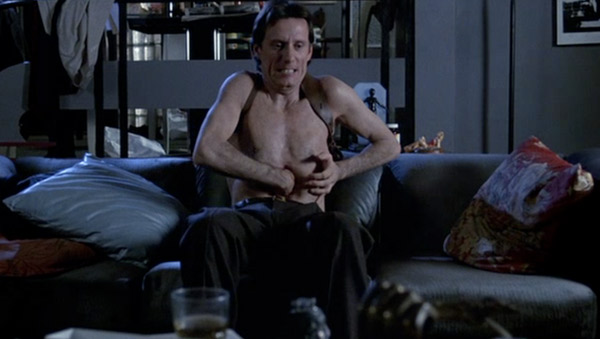
Many of Cronenberg's early films express fear of corporate or government conspiracy in them, exploiting science for some dark and barely comprehensible end. Videodrome is no different, with a shadowy conspiracy who want to make North America strong by weeding out the weak, the deviant and the undesirable, turning them into programmed assassins for the new world order. Max has already begun to change and soon he's completely under their control - programmed by videotape inserted into an orifice that opens up in his stomach. Betrayed by Harlan, who never really intercepted the Videodrome broadcast - he brought it to Max specifically.

I know that remote is in here somewhere...

The first time I watched the movie I took the more outrageous changes in Max - the stomach slot, the gun-hand - as if they were literal. That he was physically changing as the result of the Videodrome signal. I don't think that's the intent, though. I think we're supposed to be seeing the film through Max's eyes, and after a certain point he's no longer viewing reality. Still, maybe Oblivion is right and TV is becoming reality, maybe Max is no longer just being programmed, maybe he's programming the world around him. It'd make the ending of the film a little bit less of a dead-end moment.


I love this show!

In some ways, we're safer than ever from a Videodrome world. Reality as represented by the cathode ray tube or LED display is no longer a few monolithic channels seen by all. Our communal reality is now realities. Our viewing is so fragmented these days - innumerable cable channels, YouTube, Twitch, Netflix - and those are mostly mainstream. You can find stuff way worse than Videodrome in a casual surf of the net. Hell, there are people Periscoping their own deaths. In a way, that makes us safer from a mass media conspiracy like Videodrome presents.

On the other hand, we've segmented ourselves into niche markets so readily that advertising doesn't even have to do research anymore. They can target specific demographics directly via the websites they frequent, the cable channels they watch, the messageboards they post on. The realities we experience are getting more claustrophobic and insular, the people we share them with reflecting only our own expectations back to us. Actually, maybe we're MORE susceptible to a reality altering signal - maybe somebody has started using one already.

Long live the new flesh.

The Bottom Line
Videodrome is a fantastic freakshow, a literal mind-bender that questions reality, physicality, sexuality and how we interface with our technology. It's good stuff, weird and disturbing. One of Cronenberg's best.

Wednesday, October 5, 2016

31 Days, 31 Horror Movies: Dark Was the Night

Been a long day, so this writeup is a bit late. Videodrome for tomorrow.

"It's the devil."

This movie is very blue. I mean the color palette, though the tone is pretty melancholy as well. I feel like I've seen a few horror movies recently that have played with monochromatic color schemes, but I can't for the life of me remember any at the moment. It works for this film, though. Everything is washed out and cold - really cold. (There are other colors - including a lot of interiors that are a washed out yellow/green - but blue is really the major tone.)

"Could we get some other colors up here? My yellow vest is turning green."

DWtN was recommended to me last year and would have sworn I'd seen it already. The initial scenes at the logging camp, in particular, felt familiar. If so, I've forgotten a fair chunk of it and was happy to find out it was a monster movie. I feel like those have been under-represented lately and I kinda miss 'em. More monster movies, please! And no, the Asylum stuff doesn't count.

The Medium
Streaming on Netflix. Good quality, as has been usual lately. The movie appears to have been shot with a digital camera, but it's only apparent in an level of artificial-feeling sharpness in some of the scenes and an occasional lack of depth. Generally the film looks good (albeit very blue).

The Movie
In an isolated forest a group of loggers goes missing. The foreman heads up to the cut looking for them, but unfortunately it's not his men that he finds. Well... not all of them, anyway.

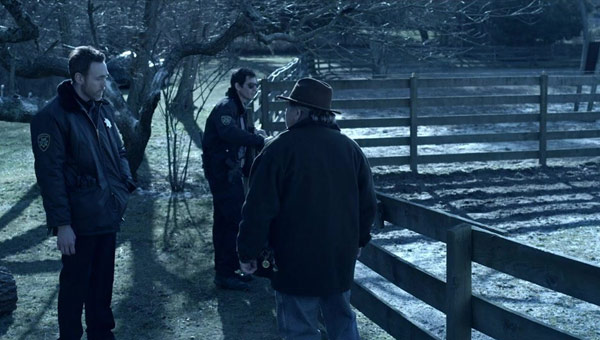
Meanwhile, 90 miles to the south, in the small town of Maiden Woods the local sheriff, Paul Shields (Kevin Durand) and his new deputy, Donny Suanders (Lucas Haas) head to a local farmer's to investigate a report of a stolen horse - though without any tracks or other evidence there's not much they can do. It's not the last we'll hear about the horses.

"I thought you only had pigs?"

I always like Durand - hell, he's the best part of The Strain - and he's really good in this role. Paul is dealing with a loss - his youngest child in an accident while in his care. In some ways he's barely holding on. He's damaged and distant - both mourning and unable to mourn at the same time. He's doing the best he can, though - taking care of his oldest son, helping Donny fit in, trying to keep the town calm in an increasingly weird situation. I like the way the filmmakers use silence and the frame to give us a sense of Paul's emotional state.  There are lots of scenes of him alone, isolated in a dark space or merely staring at nothing, motionless.  

The rest of the cast is pretty good as well, with Lucas Haas as Donny doing a good job with the big city cop carrying some secrets of his own. Bianca Kajlich is also quite good as Paul's estranged wife, Susan.  

The next day Donny shows up early at Paul's house and shows him a set of large tracks around the property - left by something with feet like horses hooves, but walking on two legs. The two of them follow the tracks, out into the road and eventually into town.

Am I the only one who wonders who has to clean up after monsters show up?
I am? Okay then...

This is my favorite part of the movie, by the way. The way the footsteps - all black - wander through the streets and backyards reminds me of stories about 'the devil's footprints' in Devon, England in 1855. (We've got our own 'devil's footprint' in Maine as well - but it's not quite as cool.) Paul and Donny follow the tracks into the woods, where they just stop - as if whatever made them had just disappeared.

This is all pretty garden variety monster movie stuff - and really, that's what Dark Was the Night IS. A good, old-fashioned monster movie. SomeTHING is out in the woods and as the movie progresses more and more weird things occur. Hunters say all the game is gone. The horses are attacked again at night. Paul and his son Adam catch a fleeting glimpse of something in the dark near their house. Then  a huge flock of birds flies over the town, fleeing south, darkening the sky. We even get the required "what is it, anyway" discussion in which the coelacanth is brought up as an example of creatures thought extinct being found in modern day. Classic!

One small nitpick, though - after the birds, Paul mentions to Donny that "it's nearer to Spring than Fall"  - but just a day or so earlier a character was talking about how it was deer season. I'm not sure where the film takes place - New York, I think - but in Maine deer season IS the fall. And no birds would be heading north.

"Where are they going?"
"They're CGI birds, Donny. Who knows where they're going."

As much of a monster movie as it is, it's the characters and production that put it above a standard B movie. You care about the characters, you want them to not only survive but find some sort of closure or redemption. As has recently been pointed out in the Horror Good Stuff thread - really good horror is scary because you care. And DWtN manages this aspect exceptionally well.

Where the movie IS let down, however, is in the same place so many creature features are these days. After an hour or so of tracks and glimpses and shaky video footage we finally get to see the big bad thing that has been terrorizing the town. And it's CGI. Bad CGI. I'll forgive a lot with practical effects, even stop motion (shoutout to Q, the Winged Serpent), but there's just something about poorly done computer graphics that rankles. And for a monster movie to have a poorly done monster... well, it's not good news.

On the plus side, this scene isn't blue!

The movie has a big siege sequence during a snowstorm, a tense and fairly well done fight in the dark in the town church and a bit of an unearned stinger ending, but to be honest the crap monster really took all the wind out of what - up until that point - was a good monster movie with an above average cast and direction.

The Bottom Line
I really like Dark Was the Night, for the most part. The story might be a standard one, but it's told well and the dialogue and characters are particularly well handled. I like the music, the editing, the cinematography. It's just too bad that the final moments involve a crap monster. It left me with a bad mental aftertaste that retroactively affects the whole film.